









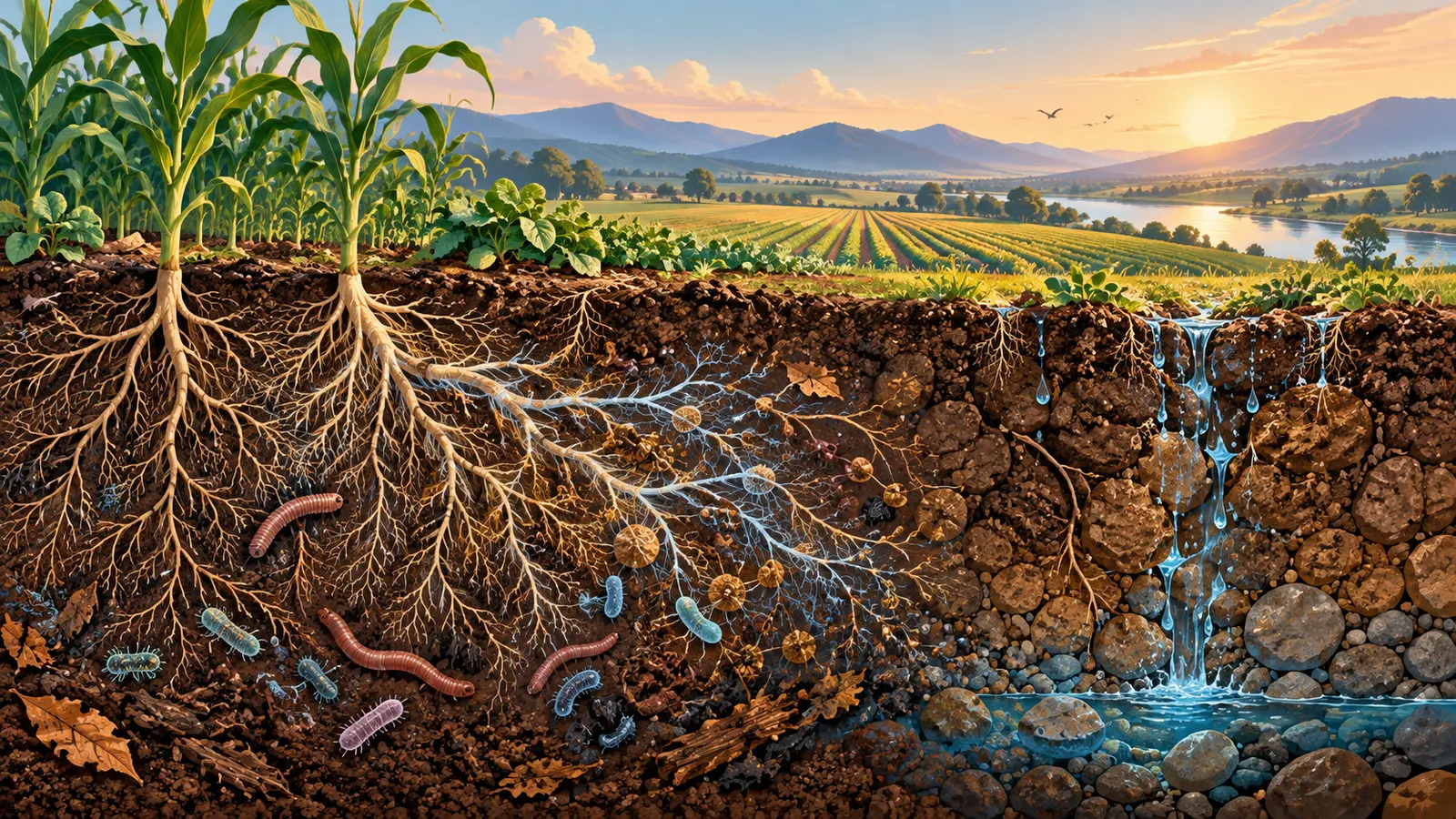
The road from a field to a plate is easy to imagine: crops are harvested, transported, sold, and cooked. The route beneath the field is less visible. Water enters pores; roots encounter minerals and microorganisms; dead material is broken down and partly incorporated into new life. Soil is often treated as dirt awaiting a seed, when it is better understood as a living and physical system that makes cultivation possible. It forms and changes through processes that rarely match the speed of a planting season. This mismatch invites a dangerous bargain: a farmer can obtain a harvest now while drawing down qualities that are harder to rebuild later.
Soil health is not one number. Texture influences how water moves, structure affects whether roots and air can enter, and organic matter can help store water and support biological activity. Nutrients are necessary, but more is not always better; excessive or poorly timed application can be wasteful and can affect water beyond the farm. Acidity or salinity may constrain what grows, even when another measure looks favourable. A field may therefore appear productive in a good season while remaining vulnerable to drought, heavy rain, or rising input costs. Yield reveals an outcome; it does not describe every condition that produced it.
Erosion gives the slow problem a sudden appearance. When intense rain moves over bare ground, it can carry fine particles into drains and rivers. Wind can remove exposed soil under different conditions. The lost material is often more valuable than its volume suggests because fertile upper layers contain organic matter and nutrients concentrated through years of biological activity and management. One storm does not explain every loss; slope, cover, tillage, and drainage all influence the result. A field protected by roots or residue may respond differently from an exposed neighbour, even under the same rain.
Proposed remedies can sound deceptively universal. Cover crops, reduced tillage, compost, diversified rotations, and better irrigation may each help under suitable circumstances. Yet a cover crop consumes water that may be scarce, plant residue may be needed as animal feed, and a new rotation needs a buyer willing to purchase its produce. Equipment, labour, and the interval before benefits appear all matter. Asking farmers to absorb every transition cost for the sake of an abstract public good is unlikely to produce lasting change. Good advice begins with local constraints and identifies who will share the risk of adopting it.
The language of 'regeneration' has become attractive partly because it promises to turn repair into a positive project. The aspiration is valuable; the label is less informative than the practices and evidence beneath it. A farm should not be declared healthy solely because it adopted a named technique. Conditions must be measured against a meaningful starting point and over an appropriate period. Greater organic matter in one layer, for instance, may be encouraging without proving that all forms of degradation have stopped. The temptation to certify a whole landscape with a single photograph or season belongs to marketing, not careful stewardship.
Soil also complicates the way societies measure efficiency. A system that produces a high yield this year using costly fertiliser, groundwater, and repeated disturbance may be efficient under a narrow accounting of land per tonne. It may look less efficient when the calculation includes water scarcity, declining structure, or the risk of future crop failure. Conversely, lower inputs do not automatically imply a better environmental result if yields collapse and production shifts onto additional land elsewhere. The relevant comparison is not a moral contest between 'modern' and 'natural' methods. It is a measured comparison of outcomes across time, place, and resource use.
Urban residents also depend on soil while rarely seeing it. Green spaces can absorb rain, support trees, and offer habitat, but compacted ground may do these jobs poorly. Construction can seal or remove fertile layers; poorly planned landscaping can place a thin decorative surface over material in which roots struggle. Public authorities sometimes count trees planted without examining whether soil volume and quality will allow them to mature. A city that celebrates its canopy goals while paving over the ground beneath them is treating soil as a disposable base rather than a necessary part of the design.
There is a further difficulty in assigning responsibility. Tenants may farm land for a short term and have little reason to invest in benefits that emerge after their lease ends. Owners may care about long-term value but lack the labour to change practice. Buyers may demand low prices while expressing support for sustainable farming. Governments may reward immediate output without accounting for the condition of land left behind. These are institutional problems as much as agronomic ones. Longer contracts, accessible testing, appropriate support, and markets for diversified crops can give conservation a practical place in a farm's decisions.
Measurements need careful interpretation. A soil sample represents a location and a depth, not an entire district. The same field can differ across a slope, and seasonal moisture changes can alter what tests reveal. Repeating a small set of useful measurements under comparable conditions may be more valuable than collecting a long list once and never returning. Farmers' observations of infiltration, crusting, earthworms, and crop response can add context to laboratory results. Neither experience nor a test report is infallible; together they can help distinguish a lasting trend from a single unusual season.
Calling soil infrastructure is meant to change how it is valued. A bridge is inspected because society recognises that failure carries a cost; a productive soil can also deteriorate before the failure becomes obvious in harvest totals. Unlike a bridge, it is alive, uneven, and inseparable from the ways people use it. Its repair requires patience and shared responsibility across farms, cities, markets, and public policy. The plate on the table may seem far removed from the dark material beneath a field. In fact, much of the future of that plate is being negotiated there, one season at a time. The first step is noticing the work that soil has been doing all along.