









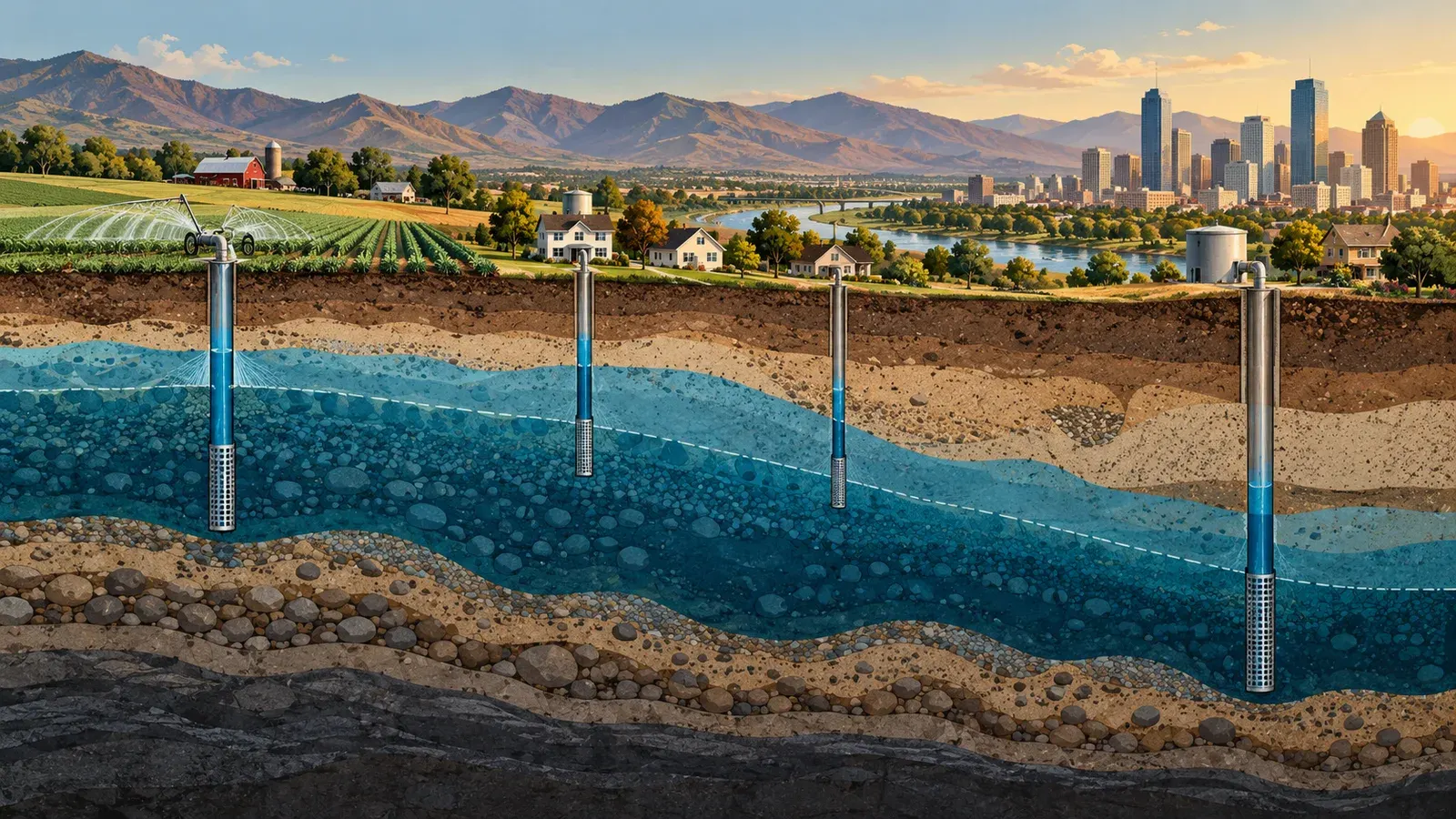
A well can make water appear wonderfully local. A household lowers a pump, turns on a switch, and receives a stream from beneath its own plot. Yet the water did not arrive at the property boundary through a private pipe. It occupies spaces within rock or sediment, moves at different speeds, and may connect the household's withdrawal to farms and wells some distance away. Because this connection is invisible, groundwater is often treated as a set of personal assets rather than a shared system. The resulting difficulty is not simply that people take too much water. It is that the signs of collective loss arrive slowly and unevenly.
An aquifer is not an underground lake waiting to be emptied like a tank. Water sits in pores and fractures, and the rate at which it can be replaced depends on geology, rainfall, land cover, and the path that water takes into the ground. A shallow sandy layer may respond to seasonal rain relatively quickly; a deeper formation may store water accumulated over much longer periods. Two wells drilled to the same depth may therefore have very different prospects. The familiar idea that annual rainfall automatically 'refills' all groundwater mistakes an input at the surface for the behaviour of a complicated underground store.
Withdrawal also changes what can be seen above ground. As the water table falls, a shallow well may cease to work while a deeper, more expensive well continues. A wealthy user can appear resilient because they can pay to drill deeper and run a stronger pump. Their adaptation may, however, increase pressure on neighbours who cannot follow. The technical ability to reach water becomes entangled with the social question of who has the means to keep reaching it. In some geological settings, excessive pumping can draw poorer-quality water into a supply or contribute to land subsidence, adding costs that a single user may not immediately face.
It is tempting to imagine that a simple price would settle the problem. If pumping becomes expensive, users should take less. But many farms and households do not measure groundwater directly, and charging for it can be difficult or politically fraught. Electricity pricing can influence pumping, yet a uniform change may punish a small farmer whose needs and options differ from those of a large enterprise. Pricing also cannot create an alternative source of water by itself. Rules must be judged by how they alter real choices, including crop markets, irrigation equipment, household access, and the reliability of public supply.
The crops grown in a region can embody decisions made far from any well. Procurement policies, market prices, credit, and consumer demand influence what farmers plant. A grower may continue to cultivate a water-intensive crop because its sale is predictable, even while recognising the aquifer's decline. Advising that grower simply to 'choose a better crop' overlooks the financial risk of being first to change. Water conservation becomes more plausible when buyers, extension services, and public institutions make less demanding alternatives viable. The unit of analysis must be wider than the pump, because the reason for switching it on may be an economic commitment made months earlier.
Recharge schemes deserve similar scrutiny. Capturing rain where it can infiltrate may help a suitable aquifer, and protecting open land from being sealed by concrete can preserve natural pathways. But a photograph of a recharge pit does not prove that meaningful quantities entered a useful formation. Soil may clog, rainfall may bypass the structure, or the water may contain contaminants. In some places recharge is constrained by geology or by a lack of clean water. A sound project specifies where water comes from, where it can travel, how it will be monitored, and who maintains the structure after its inauguration.
The most persuasive local arrangements often bring users into the same conversation. If neighbouring farmers can examine well levels together, they can see a shared trend that no single well owner's memory captures. Agreements on planting, pumping hours, or protection of recharge areas may become more credible when people understand the aquifer they depend on. Such cooperation is not automatically fair. Powerful owners may shape the rules, while landless households and people collecting water for domestic use may be excluded. Representation is therefore part of water management, not an optional exercise in goodwill.
Uncertainty complicates every decision. A few measurements in a large district cannot describe all of its aquifers, and a wet season can temporarily disguise long-term decline. Conversely, a dry year need not prove that a local recharge project failed. The useful question is whether institutions can track levels and water quality over time, record withdrawals where feasible, and revise rules when a pattern becomes clearer. A monitoring system has value only if someone is authorised to respond to what it reveals. Data displayed without the capacity to change incentives is a sophisticated way of watching a problem continue.
Groundwater discussions sometimes frame the issue as a contest between individual freedom and central control. The real possibilities are more varied. Public authorities can publish credible information, regulate new extraction in stressed areas, improve surface supply, and align agricultural incentives. Communities can negotiate practices fitted to their geology and livelihoods. Neither level can do the other's work entirely. A national rule cannot know every fracture in the rock; a village agreement cannot rewrite a distant procurement policy. Coordination across scales is essential precisely because the water moves through boundaries that institutions have drawn for other purposes.
The well's apparent privacy is therefore an illusion with practical consequences. The stream in a pipe is immediately useful to one household, but the condition of the aquifer reflects many withdrawals and years of recharge. Stewardship requires people to recognise a shared account whose balance cannot be read from a single pump. Where that recognition is backed by measurement, fair rules, and credible alternatives, restraint becomes possible. Where it remains a moral appeal delivered to users facing unchanged incentives, the deepest wells may survive longest while the common resource becomes steadily less accessible to everyone else.