









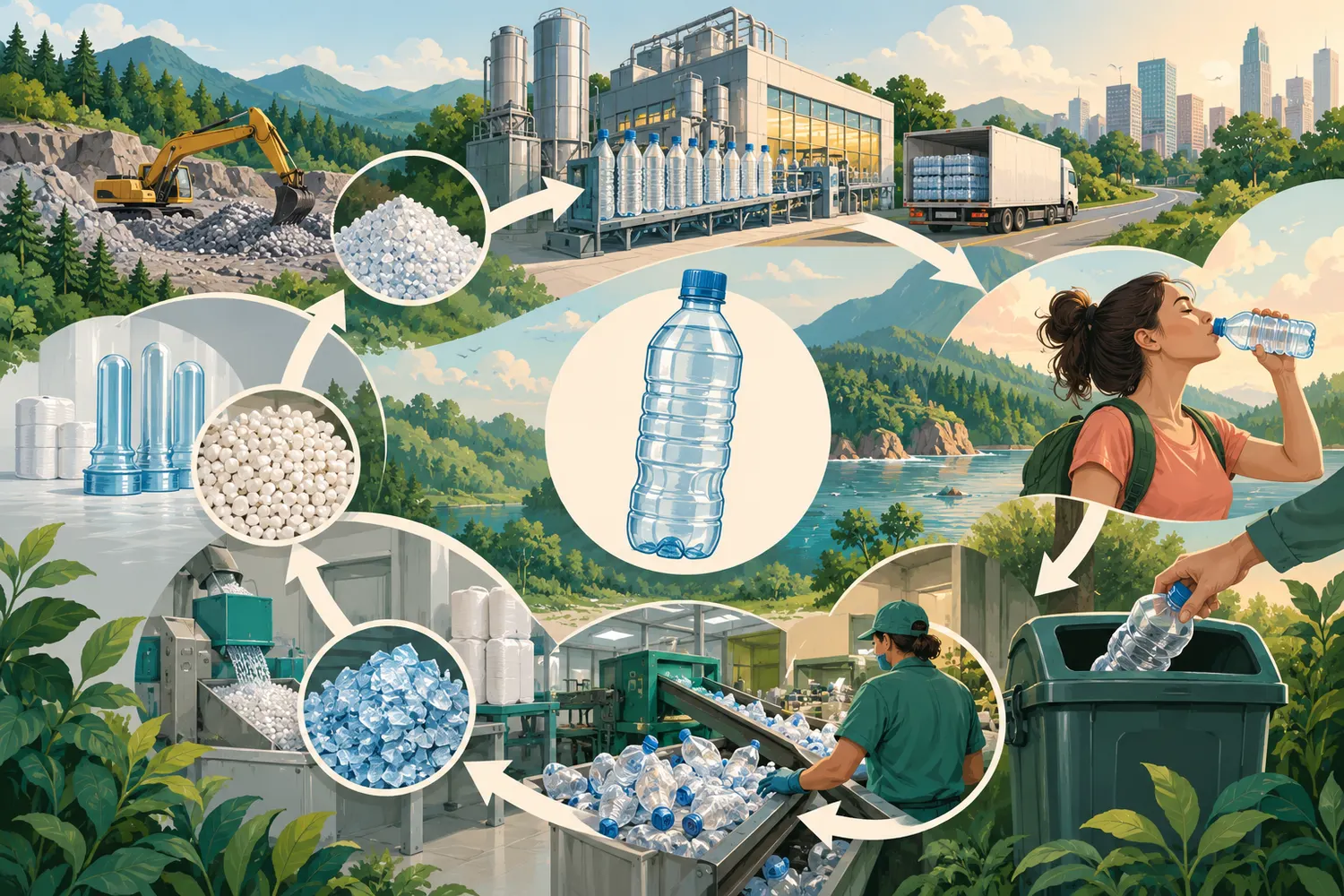
A plastic wrapper serves its immediate purpose with remarkable efficiency. It protects a product, weighs little, and is cheap to transport. Its usefulness may last minutes; the material can remain in circulation or in the environment far longer. This difference in timescales gives disposable objects their peculiar environmental character. A buyer sees the benefit at the moment of purchase, while the costs of collection, sorting, leakage, and disposal appear later, often in another place and under another institution's budget. To understand plastic pollution, it helps to follow an object beyond the bin rather than treating the act of throwing it away as the end of its story.
Plastic is not one material with one destination. Bottles, films, multilayer packaging, and medical items differ in composition and use. A clean bottle collected in sufficient quantity may have a recycling route; a small packet contaminated with food may be much harder to recover. Labelling an object 'recyclable' can describe a technical possibility without showing that collection, sorting, and a buyer for the recovered material exist where it is sold. Consumers often receive an instruction about disposal while the conditions needed to follow it remain uncertain. A credible claim must include the practical system, not only the properties of the polymer.
Collection itself involves people whose work is easy to overlook. Waste pickers may recover valuable materials from streets and disposal sites, creating income while keeping some waste out of waterways. Their labour can be dangerous and poorly rewarded. A new formal system that ignores them may destroy livelihoods and lose knowledge about which materials actually have markets. Inclusion, safer working conditions, and fair payment can improve the system. But romanticising informal recovery would also be a mistake: a society should not use the ingenuity of vulnerable workers as an excuse to avoid designing packaging that is easier to collect and process.
Recycling has limits even when it functions well. Materials may lose quality through use or processing, different plastics may need separation, and collection takes energy and money. Some objects cannot be recycled economically at scale with current systems. These difficulties do not make recycling worthless; they locate it within a hierarchy of choices. Avoiding unnecessary material, designing for reuse where practical, and making the remaining waste simpler to recover can reduce pressure on the final stages. The hierarchy is contextual. A reusable container that must be transported long distances and washed inefficiently may not always outperform a lightweight alternative, so the comparison must consider actual patterns of use.
Single-use packaging also solves real problems. It can preserve food, enable small purchases, and help maintain hygiene. A blanket demand to remove every wrapper would overlook the consequences for food waste, access, or health. The better question is which functions need that particular package and which can be met with less material or a different distribution system. Standard container sizes, refill options, and bulk delivery may work in some settings but require space, cleaning, and reliable logistics. A promising pilot should be judged after the excitement of launch, when breakage, inconvenience, and ordinary human habits become visible.
Responsibility is often placed almost entirely on the individual: carry a bag, sort the waste, refuse a straw. These actions can matter, especially when systems support them. Yet producers choose materials and combinations long before a shopper reaches a shelf. Local authorities decide whether separated waste stays separated after collection. Retailers influence whether refill systems are convenient. Rules that assign producers responsibility for the later life of packaging can change design incentives, provided those rules are measurable and enforced. Otherwise the most attractive claim on a label may be a claim about responsibility that nobody has to demonstrate.
Pollution travels in ways that complicate a neat local account. A wrapper lost from a bin can move through a drain into a river and eventually a coastal environment. Larger pieces can break into smaller fragments, making recovery more difficult and exposure pathways more complex. Scientists continue to study the specific effects of different forms of small plastic particles in different settings; uncertainty about a particular health effect should not be confused with uncertainty about whether visible waste harms habitats and public space. Preventing leakage is sensible even while research refines our understanding of every possible consequence.
Incineration and landfill present choices rather than magical disappearance. Burning mixed waste can reduce volume and sometimes recover energy, but pollution controls, waste composition, and emissions matter. Landfill can confine waste more predictably than open dumping if it is properly designed and managed, yet it requires land and long-term oversight. Exporting waste to another jurisdiction may make one city's statistics look cleaner without resolving the underlying burden. A full account asks where residues go, who monitors facilities, and what happens when maintenance money becomes scarce. Every destination remains a place inhabited by someone.
Good policy needs a clear unit of measurement. A city could report a higher recycling rate while the total amount of packaging rises sharply, leaving more material to manage overall. A firm might reduce the weight of one package but introduce additional layers that are harder to separate. Counting pieces, weight, leakage, and actual reuse can produce different pictures. No single metric can settle every design choice. The aim is to choose measures tied to the harm being addressed and to reveal when a claimed improvement shifts costs to another stage of the object's life.
The wrapper's story is ultimately about distance between benefit and burden. It is easy to enjoy a brief convenience because the work it creates is dispersed across cleaners, waste pickers, municipalities, waterways, and future budgets. Following that chain does not require us to declare all plastic unnecessary. It asks us to decide which uses justify their full costs and to build systems that make those costs visible to the people choosing the material. An object should not become economically attractive merely because someone else is expected to manage its ending. The question a designer should ask is not only whether a package survives its journey to the customer, but whether a plausible journey exists for it afterward.