









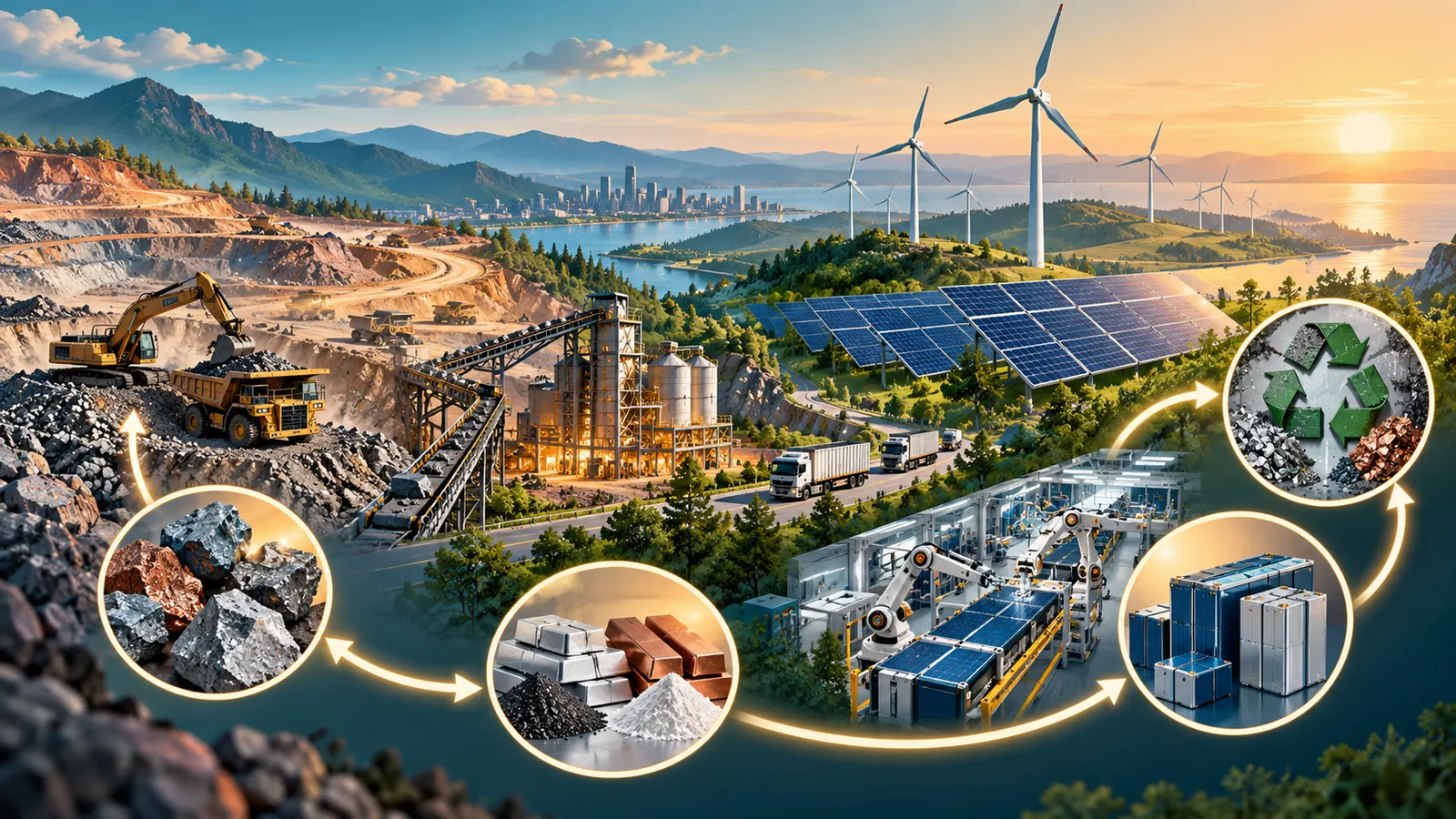
A solar panel seems to make electricity out of sunlight, which arrives without a bill from a mine. A wind turbine uses moving air rather than burning fuel at the point of generation. These descriptions are true and incomplete. Panels, turbines, batteries, transmission lines, and the buildings that house them require minerals, manufacturing, transport, and land. Recognising this material side does not weaken the case for cleaner energy. It makes the transition more serious: replacing a polluting system involves constructing another physical system, with choices about whose land is used, which resources are extracted, and how equipment is maintained and recovered.
The comparison with fossil fuels must be made carefully. A coal plant needs fuel delivered continually during operation; a wind farm requires substantial materials to build but does not consume fuel in the same way while generating electricity. The balance of impacts depends on a technology's entire life, the energy used to manufacture it, its performance, and what happens at retirement. A photograph of an open mine associated with a battery does not settle the comparison, just as a photograph of a working solar panel does not erase its production history. Environmental reasoning needs consistent boundaries for both sides of a claim.
Demand for particular minerals can create concentrated pressure. An extraction site may affect water, habitats, and nearby communities even when the metal eventually supports lower-emission transport or electricity. The benefits may be spread across distant consumers while the immediate costs are local. Consent, safety, labour conditions, waste management, and a fair share of value become part of climate policy. It is not enough to call a mineral 'critical' and assume that urgency excuses weak oversight. A transition that routinely externalises harm will have trouble sustaining public trust, especially where communities have heard promises from earlier extractive projects.
Nor is supply simply a question of opening more mines. A deposit must be assessed, financed, developed, and connected to processing capacity, and each stage takes time. Some materials can be substituted in particular applications, though substitution may create new technical trade-offs. More efficient designs can reduce the amount of material needed per unit of service. Reuse and recycling can recover resources from equipment that has reached the end of its first life, but they cannot immediately supply a rapidly expanding system when most installed equipment is still in use. Planning requires attention to timing, not only to the theoretical amount of metal available on Earth.
Electricity networks illustrate the less glamorous part of the transition. A new generator is useful only if power can reach people when they need it. Lines take materials, land, permits, and agreements with communities. Storage, flexible demand, and more varied generation can help balance a system in which sun and wind change over time. They are not identical solutions: a battery that handles evening demand does a different job from a network connecting regions with different weather. The challenge is systemic, which means celebrating one device without investing in its connections can produce impressive capacity figures and disappointing practical results.
Land use also requires context. A solar installation on a roof has different consequences from one placed on a productive field or habitat. Wind turbines occupy particular sites while allowing some surrounding land uses to continue, although roads and transmission routes can fragment habitats. Energy planning should compare alternative locations, consider local livelihoods, and examine whether existing buildings and infrastructure can carry some of the demand. The desire to build quickly is understandable, but speed gained by dismissing local concerns can later be lost through conflict. Participation is a way to improve a design before its costs become fixed.
Efficiency is an often overlooked source of freedom in this debate. A building that needs less cooling or a transport system that makes journeys shorter can reduce the amount of new generation and material required. But 'use less' is an uneven instruction. A household struggling for basic energy access cannot be treated like a wealthy household with many discretionary uses. Policies should distinguish essential service from avoidable waste. Better insulation, reliable public transport, and efficient equipment can improve living standards while changing the scale of infrastructure needed. Demand is shaped by design and institutions, not only by personal virtue.
Technology choices will evolve, so forecasts deserve humility. Prices, chemistry, performance, and supply chains can change, while public decisions about land and infrastructure can last decades. This is a reason to avoid plans that depend entirely on one material or one model of demand. It is also a reason to invest in repairability, standards, and information about where materials come from. Flexibility is not the same as indecision. A well-designed system can act now while preserving several routes for responding to new evidence rather than locking every future choice into a single assumption.
The distribution of the transition's benefits deserves as much attention as its material inputs. A city may install clean generation while some residents still lack reliable power. A mining region may see heavy traffic and water demand without affordable electricity or durable jobs. Public policy can address these divisions through transparent contracts, local services, worker protection, and plans for eventual closure. None of these measures makes extraction harmless. They make its costs visible and negotiable, which is a precondition for judging whether a project should proceed at all.
The phrase 'clean energy' names an important direction, not an exemption from scrutiny. Moving away from continual fuel combustion can offer substantial benefits, yet panels and turbines are made in places where people and ecosystems live. The question is not whether a perfect technology exists. It is whether we can compare alternatives honestly, reduce avoidable harm, and build the institutions needed to share gains and responsibilities. A credible transition can acknowledge every component of its material footprint without losing sight of the much larger system it seeks to transform. Concealing these costs would leave the people who bear them less able to bargain over how projects proceed. Making them visible allows environmental goals to be argued for in public rather than taken on faith.