









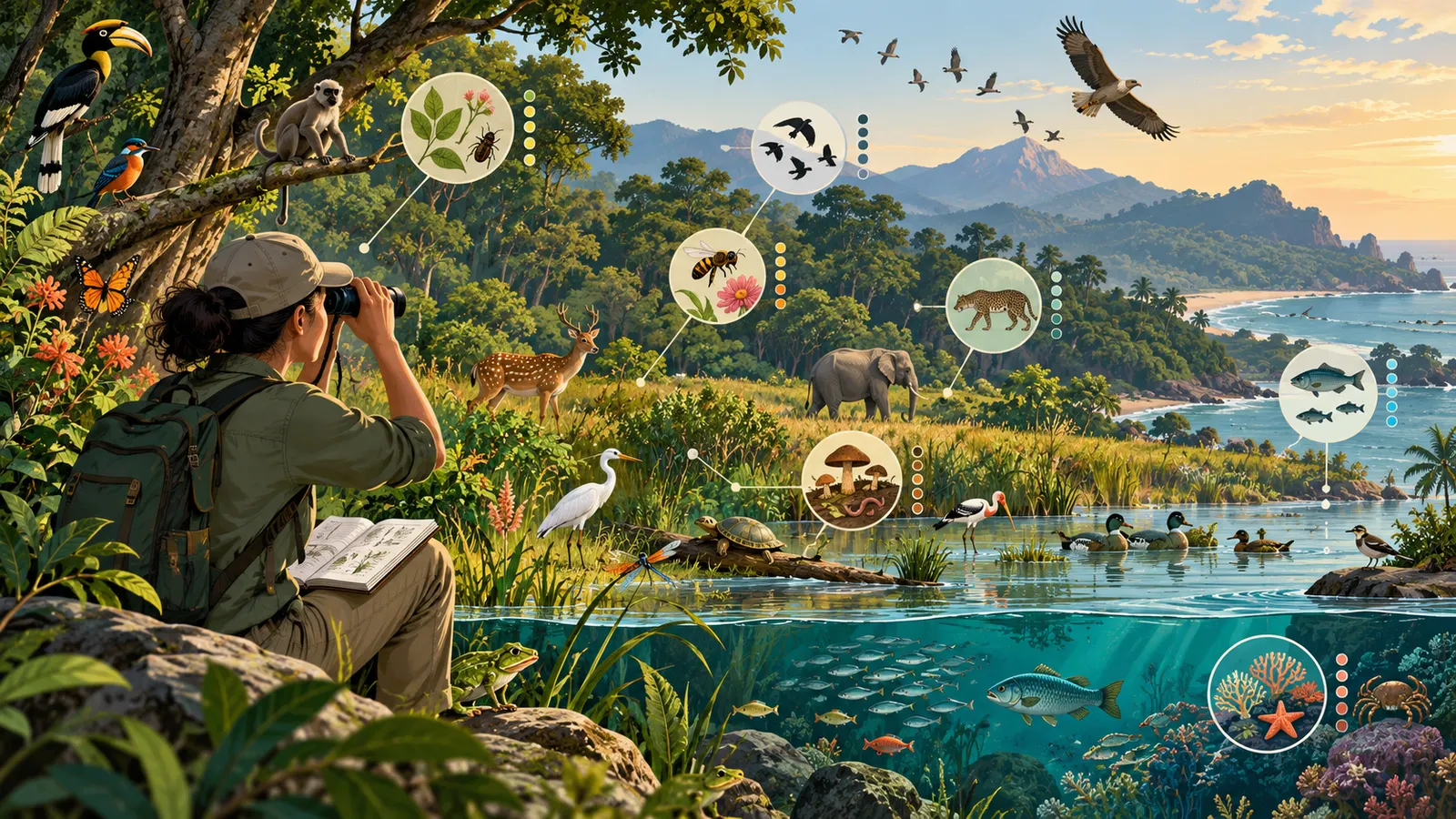
A forest survey might report the number of bird species observed within a boundary. An increase sounds encouraging, while a decrease sounds alarming. Both reactions may be justified, but a count cannot, by itself, tell the whole ecological story. Ten birds that thrive in many disturbed places are not interchangeable with ten birds that depend on an old, layered forest. A new road may bring easily observed species into an area even as more specialised species retreat. Biodiversity is therefore more than a tally of names. It concerns relationships among organisms, habitats, and the conditions that allow those relationships to persist.
The counting problem begins with observation. A survey records what its methods can detect during a particular period. Birds may sing at different times of day; plants can be difficult to identify outside flowering season; elusive mammals may leave tracks without appearing before a camera. If two surveys use different effort or methods, a change in the list may reflect a change in observers rather than in nature. This does not make counting pointless. It makes careful design essential: comparable seasons, repeated visits, and explicit limits on what a result can support. A number becomes more informative when its conditions of production are visible.
Even reliable species counts can conceal ecological roles. Insects pollinate plants, fungi move nutrients through soil, predators affect the behaviour and abundance of prey, and decomposers return dead material to circulation. These descriptions are general, and the details vary widely across ecosystems. Yet they show why a decline in an inconspicuous organism can matter beyond its own survival. Conversely, discovering a familiar species in a city park does not establish that the park can support a functioning version of the habitat from which it came. The task is to ask what organisms do together, as well as how many appear on a list.
There is a danger in reducing those roles to their usefulness for people. Pollination may be discussed as a service to agriculture, forests as carbon stores, and wetlands as flood protection. These practical arguments can make protection politically legible. They can also imply that an organism without a clearly priced service has little claim to survive. The ecological world is not organised around the ease with which human institutions can calculate benefits. A modest case for restraint is that our knowledge of connections is incomplete. A deeper ethical case is that not every living thing needs to justify its existence in a market's vocabulary.
Habitat size and connection matter as well. Two patches with similar species lists can offer different futures if one is isolated and the other connects to a wider landscape. Animals may need to move between feeding and breeding areas, while plant populations can depend on the movement of pollinators or seeds. A narrow corridor is not magically sufficient; it must be suitable for the species expected to use it and safe from the pressures that made movement difficult. Conservation planning therefore requires more than colouring disconnected parcels green on a map. It must examine the processes that cross the spaces between them.
Human activity does not always create a simple division between ruined and untouched nature. Some landscapes have been shaped by grazing, farming, fire management, or seasonal harvesting over many generations. Removing those practices without studying their ecological effects can alter a habitat in unintended ways. This observation must not become a blanket defence of any land use. It is an argument for specificity: which activity, at what intensity, under whose control, and with what evidence of its consequences? Conservation that assumes every human presence is harmful may overlook forms of stewardship; conservation that assumes all traditional activity is harmless may overlook changing pressures.
Climate change makes fixed boundaries still more complicated. A reserve may protect present habitat, but temperature and rainfall conditions can shift. Species may need routes to move, and some may be unable to keep pace. Managers face difficult choices about whether to intervene, what to restore, and how to avoid making matters worse. The familiar image of preservation as holding nature still can mislead. A living system changes even without human disturbance; the challenge is to protect its capacity for change without accepting avoidable damage as inevitable. That requires monitoring over time rather than celebrating a single successful count.
Policies often seek one headline indicator because decisions require comparison. A city cannot inspect every organism before choosing where to build a road. Indicators are therefore useful summaries, provided they are treated as clues rather than verdicts. A programme might track habitat condition, the status of vulnerable species, connectivity, and pressures such as pollution or extraction alongside overall richness. Different measures answer different questions. A rise in total species numbers alongside a decline in specialists deserves investigation, not a victory announcement. The quality of an environmental decision depends partly on whether its chosen indicators can reveal an uncomfortable result.
The people living near habitats need a place in this reasoning. Restrictions that protect a forest can also affect access to fuel, grazing, or work. A plan that ignores these costs may provoke resistance or move damaging activity elsewhere. Equally, a claim that local use is necessary does not automatically settle whether its present scale is sustainable. Open records, meaningful participation, and fair ways to handle trade-offs are practical conservation tools. Ecological knowledge gathered through field science and knowledge built through daily experience can challenge and refine each other when institutions create room for both.
A species list is a beginning, not an ending. It can tell us that living things are present and prompt us to ask why particular organisms appear or disappear. It cannot alone say whether a place is healthy, connected, or able to endure the pressures ahead. If we count carefully and then refuse to stop counting at names, biodiversity becomes less like a contest for the longest inventory and more like an inquiry into how life holds together. That inquiry is slower than a headline, but it is also closer to the reasons conservation matters.