









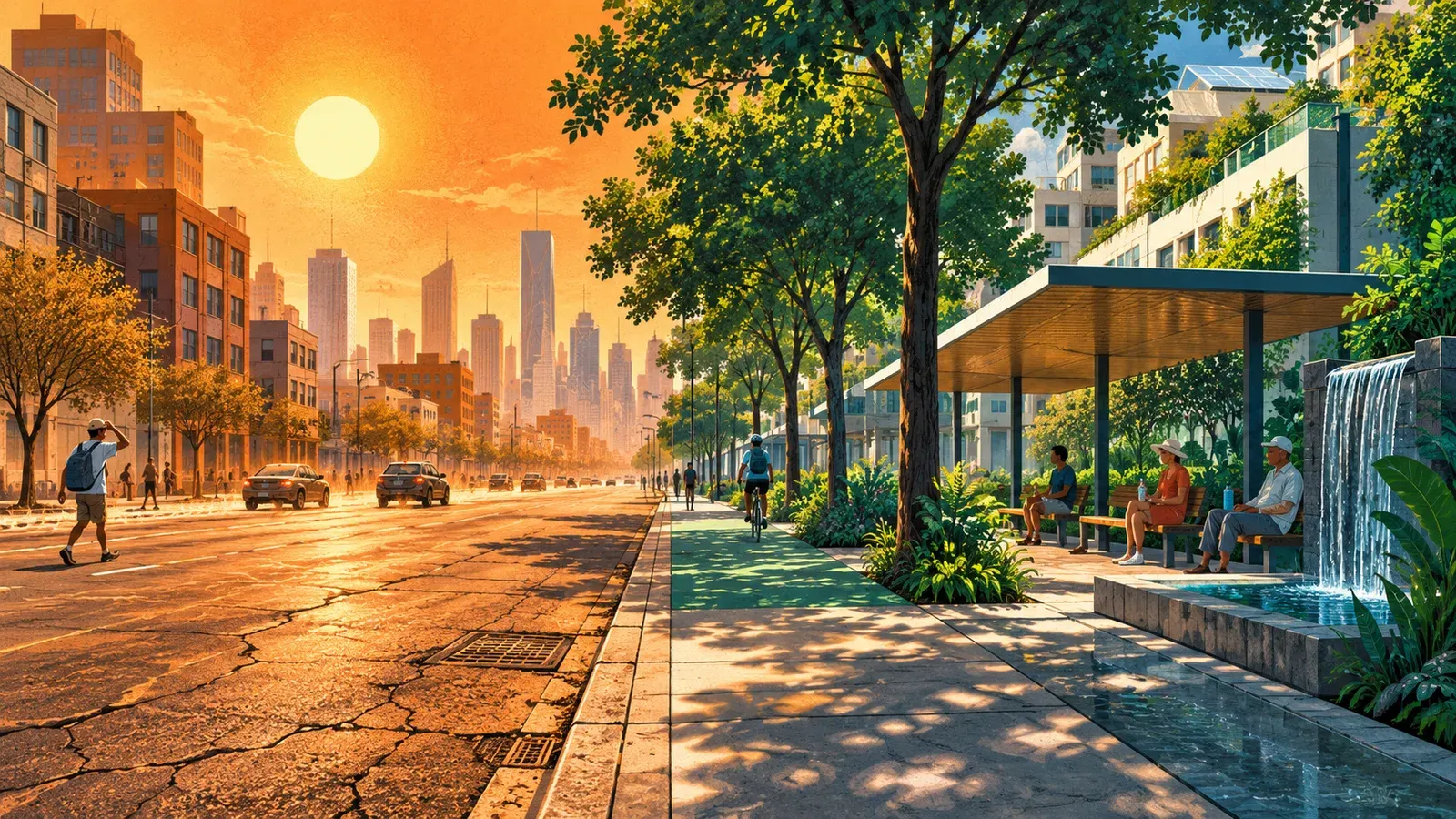
On a hot afternoon, two people can stand beneath the same temperature reading and experience entirely different dangers. One leaves an air-conditioned office and crosses a tree-lined street. The other sorts deliveries beside an asphalt road, then returns to a single-room home beneath a sheet-metal roof. The thermometer registers air temperature, but a body encounters sunlight, humidity, ventilation, physical effort, and the possibility of escape. This difference matters because heat is often discussed as a weather event, when its consequences are partly designed into a city. A serious response begins by asking where exposure occurs, who cannot avoid it, and which institutions can change those conditions.
Heat behaves differently from many disasters. A flood can leave a visible mark on a wall; heat frequently leaves none. Its effects may appear as exhaustion, lost working hours, disrupted sleep, or a worsening of an existing illness. A person who grows dizzy while travelling may not describe the episode as an environmental emergency. Nor does an ordinary daily maximum convey what happens when nights remain warm. Bodies recover during cooler hours; when that interval disappears, several tolerable days can become dangerous together. The timing and duration of exposure are therefore as significant as the headline number announced in a forecast.
Urban surfaces can intensify the problem. Dark roads and rooftops absorb sunlight and release stored heat after sunset. Buildings can block breezes, while sparse vegetation removes shade and evaporative cooling. Yet the phrase 'urban heat island' risks suggesting a single, uniform island. A shaded courtyard and an exposed bus stop may be separated by only a few hundred metres. A neighbourhood map assembled from satellite images can identify hot surfaces, but it cannot alone reveal whether residents have drinking water, whether buses arrive reliably, or whether a worker is permitted to stop. Measurement becomes useful when joined to knowledge of daily routines.
Trees are an appealing answer, and often a valuable one. A mature canopy shades pedestrians, alters the immediate surroundings, and can make public space usable for longer. But planting a sapling in a photograph is easier than keeping a tree alive for decades. Roots need space, soil needs water, and branches must coexist with cables and buildings. Species choices matter, as does the distance between the tree and the people who need it. A plantation counted in a citywide target may provide little relief to a pavement worker if it grows behind a gated compound. Maintenance and equitable placement are part of the intervention, not administrative details added later.
Buildings offer another set of choices. A reflective roof can reduce the heat absorbed by a structure, but the benefit inside depends on insulation, ventilation, and the building's design. Windows that admit a pleasant winter breeze may admit punishing afternoon sun in another season. Dense housing often limits what an individual tenant can alter. A policy that advises residents to 'stay indoors' assumes that indoors is safer; in poorly ventilated rooms beneath hot roofs, this may be false. Retrofitting, building standards, rental arrangements, and electricity reliability shape the protection that an instruction can realistically provide.
The temptation is to measure success through one dramatic figure: the number of trees planted, cooling centres opened, or alerts issued. Each figure can conceal a harder question. Was the centre near the people who could not travel far? Was it open after work, and could someone enter without documents or embarrassment? Did the alert reach outdoor workers in a language and format they use? Did employers allow breaks during the hottest hours? An intervention may exist on a municipal dashboard without changing the choices available to the person most exposed. Counting provision is necessary; testing access is indispensable.
Heat also forces a conversation about work. Moving outdoor labour to cooler hours sounds sensible until one asks whether public transport runs at those hours, whether lighting is safe, and whether a night shift deprives workers of rest. Some tasks cannot be postponed without affecting sanitation, food delivery, or construction. Protection may therefore require a combination of shaded rest, drinking water, adjusted schedules, wage safeguards, and clear responsibility among contractors. A warning that tells a worker to stop without protecting income can shift the burden from institutions onto the person least able to carry it.
There are tensions between immediate relief and longer-term adaptation. Air conditioning can prevent harm in a particular room, especially for people at high risk. If widely adopted without attention to efficiency and electricity supply, however, it may increase peak demand and release more heat outdoors. That does not make cooling morally suspect; it means access and infrastructure must be planned together. Passive design, reliable power, emergency shelter, and efficient equipment solve different parts of the problem. Cities should resist presenting one technology as a universal substitute for public space, housing quality, and humane work rules.
A fair heat policy also needs evidence without waiting for perfect evidence. Health records may not identify heat as a contributing factor, and people living in informal housing may be absent from detailed maps. Local surveys, temperature sensors, hospital observations, and workers' accounts can together reveal patterns that no single data set captures. Authorities should be willing to revise an alert threshold or relocate a cooling site when experience shows that the original design missed people. Treating uncertainty as a reason for inaction would be especially strange when the purpose of monitoring is to improve decisions while conditions change.
The larger lesson is that adaptation is not merely a matter of preparing for an exceptional day. It is a way of reconsidering ordinary arrangements: who waits outside, who controls working hours, whose roof is repaired, and whose street receives shade. Heat becomes a crisis through an encounter between weather and the distribution of protection. A city cannot change the sun. It can change many of the circumstances through which the sun becomes a threat. The quality of its response will be judged less by how loudly it announces danger than by how much room it gives people to remain safe.