









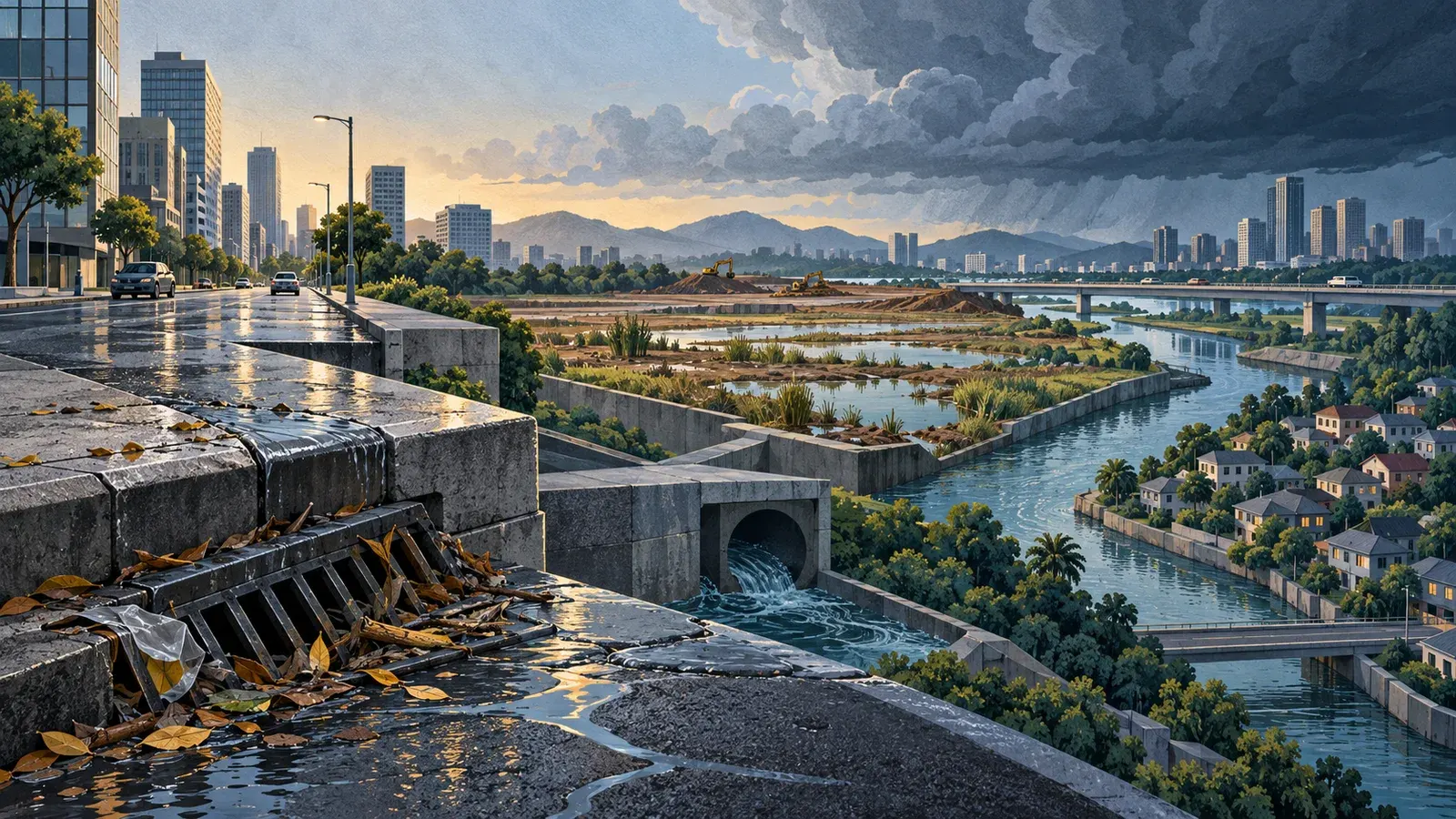
When streets fill with water, the immediate cause seems obvious: rain fell faster than drains could carry it away. This explanation is sometimes true and almost always incomplete. A flood is also a record of earlier decisions about where water was allowed to go. A stream narrowed, a pond filled, a low-lying field paved over, or a drain left without maintenance can turn a heavy downpour into a disaster. Rain is an event; the city's vulnerability has a history. Understanding that history is useful because rainfall cannot be negotiated with, while many of the conditions that intensify its effects can be changed.
The first challenge is to see a city as a catchment rather than a collection of plots. Water falling on an upstream roof can flow across a road, enter a drain, reach a stream, and affect a neighbourhood downstream. Ownership maps usually divide these places into separate parcels and jurisdictions. Water does not consult them. A development that keeps its own compound dry by sending runoff rapidly into a public channel may make another area less safe. The apparent success of a local drainage project can therefore be a transfer of risk, invisible until the next storm arrives.
Hard surfaces alter both the speed and the volume of runoff. Soil and vegetation can absorb or slow some rainfall, although their capacity is limited during intense or prolonged storms. Concrete and asphalt provide far less opportunity for infiltration. When many plots shed water at once, channels that once handled a slower flow can be overwhelmed. Yet it would be simplistic to propose that every paved surface be replaced by a garden. Cities need roads, homes, and public facilities. The practical task is to preserve space for water where it matters most and to account for the consequences when land is made less permeable.
Wetlands, ponds, and floodplains are sometimes described as vacant land. Their value may be least obvious during dry weather, when a parcel appears unused to an observer seeking constant visible activity. During rain, however, these spaces can store, delay, or direct water. Filling them may create saleable land and an immediate financial gain while removing a service shared across a much larger area. Restoring a pond after surrounding buildings have been erected is considerably harder than protecting it in the first place. The economics of development often records the value of a new structure more clearly than the avoided damage created by a place left open.
Engineered drains remain essential, but capacity alone does not determine whether they work. A large channel may fail if outlets are blocked, pumping stations lose power, or waste clogs a narrower section upstream. Regular cleaning sounds mundane beside an ambitious new project, yet neglected maintenance can cancel the benefit of expensive construction. The design also depends on an estimate of the storm it should handle. A system built for a particular pattern of rainfall may struggle when storms become more intense or conditions change. Engineering must therefore include inspection, repair, and the willingness to revisit assumptions rather than treating the day of construction as the end of the project.
Warnings can reduce harm even when infrastructure cannot prevent every flood. A forecast may identify heavy rainfall, but residents need information at a scale that helps them decide whether to move vehicles, protect documents, avoid an underpass, or leave a ground-floor room. The message must reach people with different phones, languages, and levels of trust. Evacuation advice also requires somewhere safe to go. A warning without a plausible action can be experienced as an announcement of helplessness. Preparedness depends on routes, shelters, and the local knowledge of where water actually gathers.
The social distribution of flood risk is rarely accidental. Affordable housing may be concentrated beside drains or on land exposed to recurring inundation. People with insecure tenure can hesitate to report danger if they fear eviction or official attention. A shopkeeper may choose to protect stock rather than leave promptly because a single lost day threatens their income. The instruction to 'avoid flooded areas' has a different meaning for a person whose home, work, and journey all pass through them. Plans that ignore these constraints are likely to describe an ideal response that many residents cannot afford to perform.
There is also a difficult question of responsibility across boundaries. A municipal drainage team may control streets but not the regional river into which water must empty. A housing agency may approve buildings without managing the canals that serve them. Waste collection, roads, electricity, and disaster response may sit with different departments. The more fragmented the authority, the easier it is for each organisation to claim that its own component functioned correctly while the whole system failed. Flood governance needs shared maps, regular coordination, and a clear decision maker when upstream and downstream interests collide.
No city can promise that an exceptionally severe storm will cause no damage. The standard should instead be whether avoidable risk has been reduced and whether recovery is organised fairly. This may mean refusing construction in a critical floodplain, repairing an ordinary drain before announcing a new one, or helping households return safely after the water recedes. It may also mean redesigning a road so that excess water moves through a less harmful route when a system's capacity is exceeded. Planning for failure is not defeatism; it is an admission that protective systems need safe ways to fail.
The phrase 'natural disaster' can make a flooded street seem detached from the city that surrounds it. Rainfall is natural; exposure and damage are shaped by land use, public services, and political attention. A storm reveals the routes along which water can move and the choices that have obstructed them. The most useful question after the water subsides is not only how much rain fell. It is which earlier decisions turned that rain into loss, which people carried the cost, and whether the next decision will make their position safer. Those decisions will often be less spectacular than the storm itself, and more consequential for the next one.