









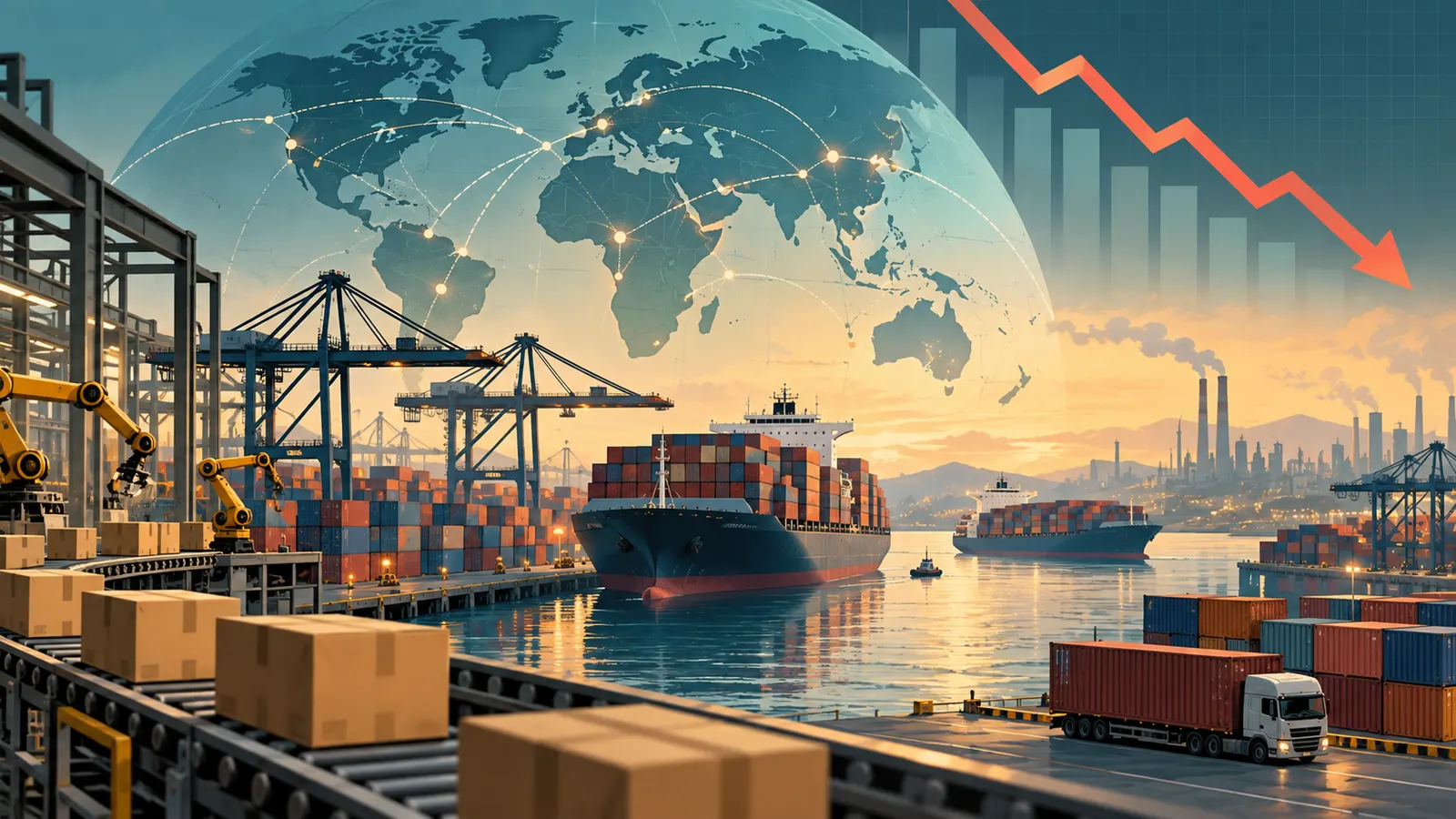
In March 2026, the World Trade Organization forecast that growth in the volume of merchandise trade would slow from 4.6 percent in 2025 to 1.9 percent in 2026, under its stated baseline. The figures describe a sharp change in pace, but not necessarily a fall in the amount of goods traded. A smaller positive growth rate means trade is still expanding, only more slowly. That elementary distinction is often lost when a slowdown is described as though it were a collapse.
The WTO connected its baseline partly to the fading of unusually strong activity in 2025, including demand for products related to artificial intelligence and imports brought forward before tariff changes. When businesses expect a future barrier, they may order earlier than usual. A surge today can then be followed by weaker growth even if underlying demand has not suddenly vanished. The calendar of purchases matters as much as the annual total.
Trade statistics are also affected by what they count. Merchandise refers to physical goods, while services include activities such as tourism, software, and consulting. Growth in one can differ from growth in the other. A headline about 'world trade' may conceal these distinctions, just as a national average can conceal the experience of a particular exporter. A manufacturer dependent on imported components may face pressure even while total trade volume looks resilient.
For consumers, trade appears in the prices and variety of products available. For firms, it shapes the markets they can sell to and the inputs they can obtain. But these benefits are distributed unevenly. A change that lowers costs for one industry can intensify competition for another. The overall gain from openness does not settle whether workers displaced in a particular place receive support or whether a region can adapt quickly. Economic efficiency and the fairness of transition are separate questions.
Tariffs receive attention because they are visible policy instruments. A government can impose them to protect an industry, raise revenue, or bargain with another government. Their effects extend through supply chains. An import tax on a component can raise costs for domestic producers using it, while the intended protected firm may gain a temporary advantage. The practical result depends on substitution, exchange rates, retaliation, and how businesses pass costs to buyers.
Not all obstacles to trade are tariffs. Delays at ports, incompatible standards, uncertain rules, and expensive finance can deter exchange even when the formal tax is low. Improvements in logistics can benefit smaller firms that lack the resources to manage long delays. Likewise, predictable rules allow businesses to make investments that require years to recover their costs. Trade policy is therefore partly about the mundane infrastructure of trust and delivery, not only about headline agreements.
The global average can be particularly misleading during a shock. Some exporters gain from higher commodity prices while importers face expensive bills. Countries integrated into a fast-growing technology supply chain may prosper as others struggle. Describing trade as a single rising or falling tide obscures the geography of gains and losses. A careful reading asks which products and regions drive the forecast and which assumptions could fail.
Forecasts also have a political life. A pessimistic outlook may be used to argue for protection; an optimistic one may be used to dismiss adjustment costs. Neither conclusion follows automatically from a projected growth rate. Policymakers need to identify the problem they hope to solve and the people likely to bear the cost of their response. A tariff can be evaluated as a specific intervention rather than as a symbolic declaration that a country supports or opposes trade.
The WTO's 2026 forecast is thus a starting point for examining changing patterns. It invites questions about temporary surges, supply chains, uncertainty, and the distinction between growth and level. Trade matters because goods and services cross borders, but its consequences are felt in particular workplaces and households. The headline number is useful when it sends readers towards those details rather than replacing them.