









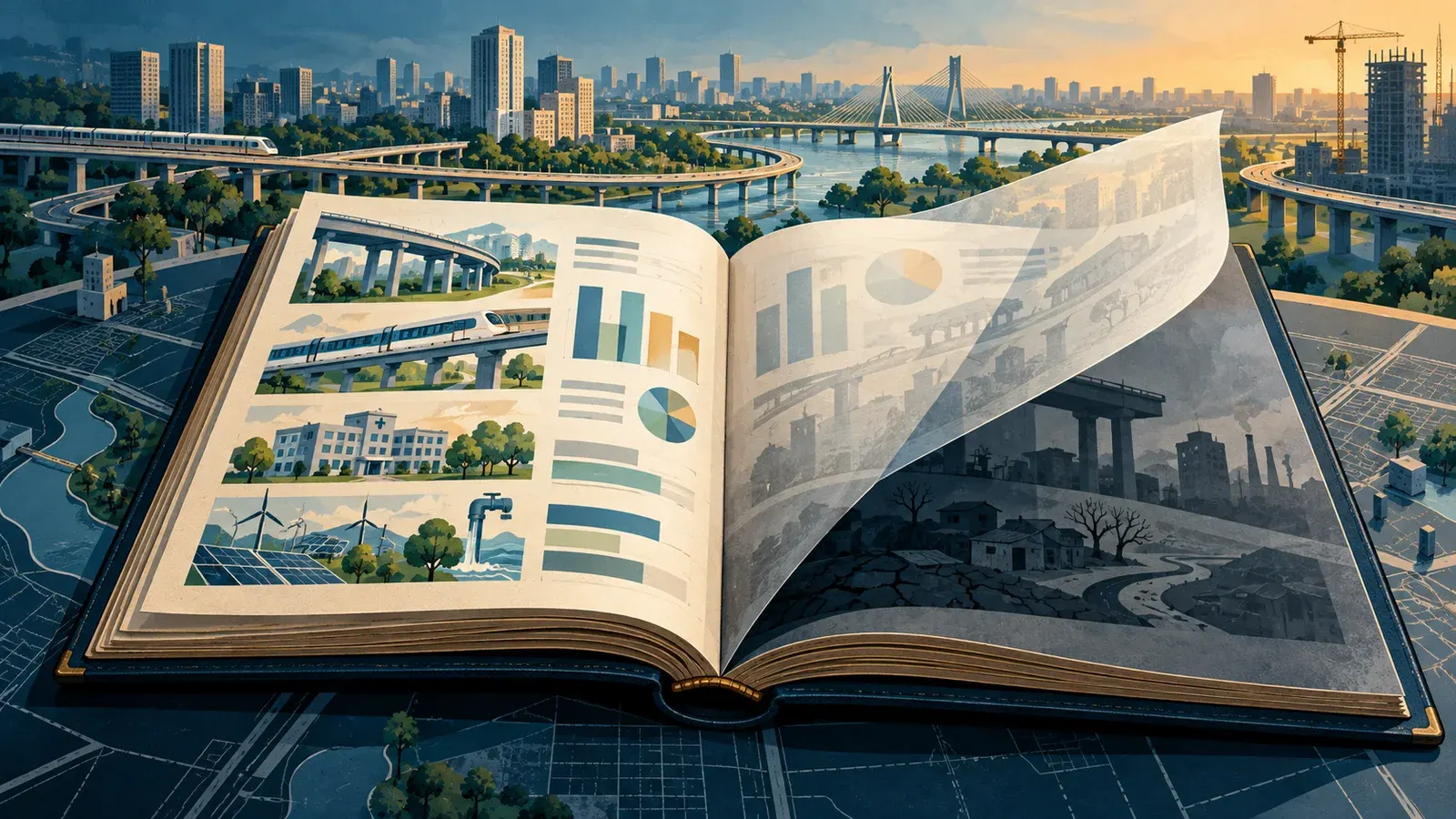
India's Union Budget for 2026-27 estimated a fiscal deficit of 4.3 percent of gross domestic product and set out plans for substantial capital expenditure. These figures can dominate the morning after a budget speech. One side welcomes public investment; another asks whether borrowing is sustainable. Both concerns are legitimate, but neither can be settled by a single number. A budget is simultaneously an accounting statement, a statement of priorities, and a forecast about a future that will not precisely follow the plan.
The fiscal deficit measures a gap between government expenditure and receipts, excluding borrowing as a receipt. It indicates how much financing must be raised under the budget's estimates. But the same deficit can arise from very different choices. Borrowing to construct an asset that serves people for many years differs from borrowing to cover a recurring expense, although both enter the arithmetic. The distinction does not make one automatically good and the other bad. Some recurring spending, such as maintenance or education, can also produce long-lasting benefits.
Capital expenditure often appeals to policymakers because roads, railways, and public facilities can support future activity. Yet the value of an allocation depends on execution. A project can be announced, delayed by land or procurement problems, and cost more than expected. A well-chosen asset can also fail to deliver its promise if operating budgets are inadequate. A hospital building requires staff and supplies; a transport link requires maintenance and connections to the places people actually need to reach.
Budget estimates are plans rather than records of completed action. Revenue may differ from projections if growth, imports, or compliance change. Spending may shift when emergencies arise. This is why a reader should distinguish budget estimates, revised estimates, and actual outcomes. A government can sincerely plan one level of expenditure and end the year elsewhere. Judging performance requires comparing what was promised with what happened and asking why the difference arose.
The phrase 'fiscal discipline' can also oversimplify. Low borrowing may be prudent when debt costs are high and revenues uncertain. It may be damaging if achieved by postponing essential repairs or reducing effective services. Conversely, a large deficit is not necessarily a sign of vision. The right assessment asks what the money buys, how the obligation will be serviced, and what alternative uses of resources were set aside. Fiscal figures constrain choices; they do not replace judgment about those choices.
Distribution is often hidden inside totals. A programme might raise average benefit while reaching groups unevenly. A tax change can affect households differently depending on income, consumption, and whether they have access to formal services. National numbers are necessary for managing public finances, but local experience can diverge from them sharply. An allocation announced for a sector is not the same as an improvement experienced by its intended users.
There is a political reason budgets emphasise beginnings. Opening a new project is visible; maintaining an existing one rarely produces an equally memorable photograph. Yet the quiet work of repair can preserve more value than a prestigious addition. A careful budget discussion asks whether maintenance and staffing have been funded alongside construction. It also asks whether several separate schemes duplicate one another, creating complexity that consumes money before it reaches a beneficiary.
Public scrutiny should continue beyond the speech. Detailed documents reveal how amounts are classified; later reports show spending and outcomes. Citizens need not memorise every table to ask useful questions. Which promises are new, and which repeat earlier allocations? Are figures expressed in current prices or adjusted for inflation? Are there credible measures of what a programme achieved? A rise in nominal spending may look substantial while buying less than expected if costs have risen.
The budget is sometimes described as a national household account. That metaphor can be helpful in conveying the existence of trade-offs, but governments can borrow over different horizons, tax economic activity, and influence the conditions under which they repay debt. They also bear responsibilities that a household does not. Treating the analogy as literal can obscure both the risks of public borrowing and the case for useful public investment.
Reading the 2026-27 budget seriously means holding two ideas together. The announced deficit and capital spending tell us something concrete about intentions and constraints. Their public value will depend on implementation, maintenance, distribution, and future conditions. An informed reader begins with the headline numbers and then follows the money into the institutions and places where promises are either realised or quietly lost.