









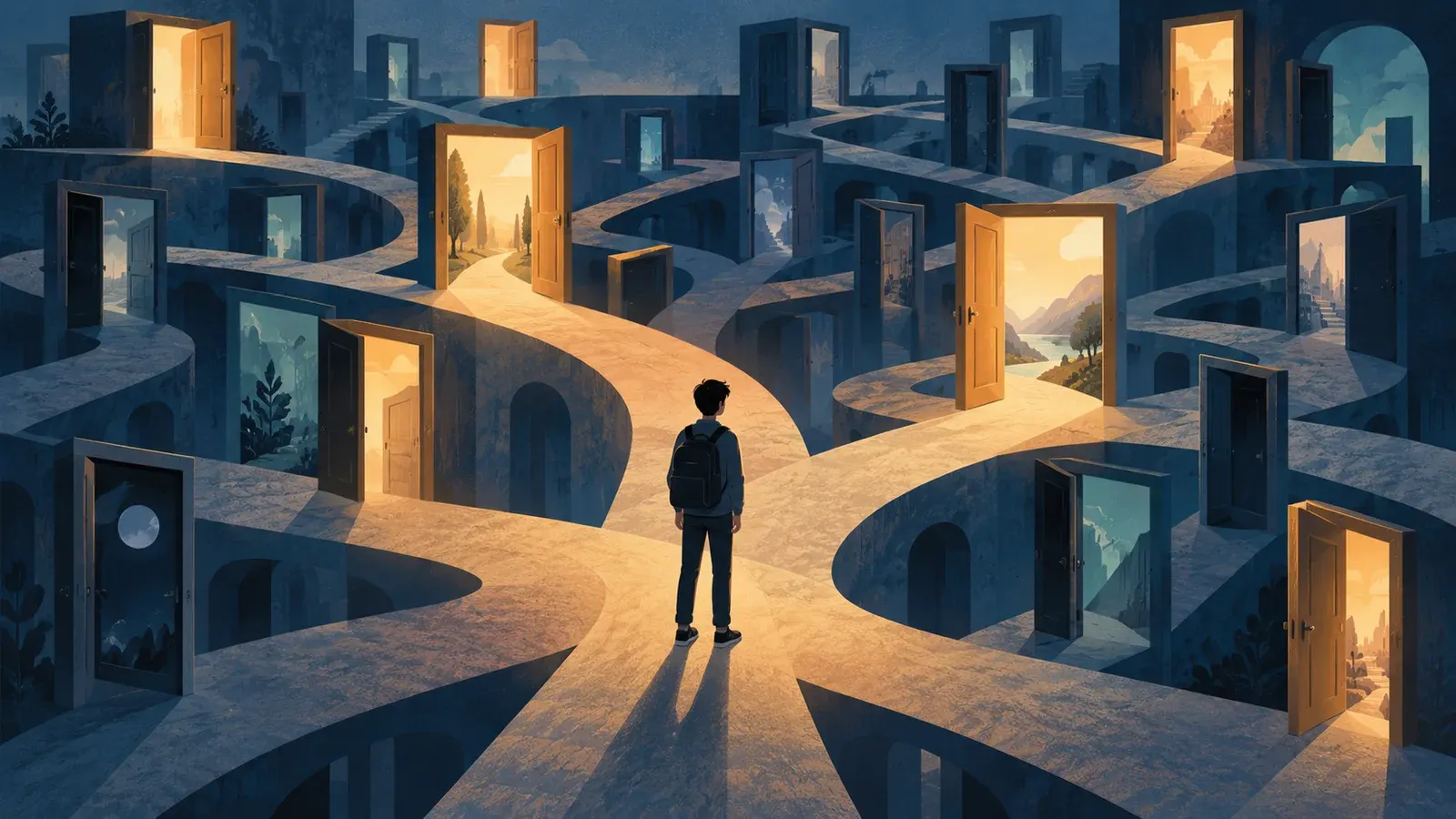
Freedom is often pictured as an expanding set of options. The shopper who can choose among fifty brands appears freer than one offered only five. The student who can select from an enormous catalogue of courses seems better served than one restricted to a modest curriculum. Yet the experience of choosing does not always improve as the number of alternatives grows. Beyond a certain point, abundance can make a decision feel less like an opportunity and more like an examination for which no one has supplied the marking scheme.
Part of the difficulty is computational. Comparing several possibilities requires attention to their features, costs, and consequences. Comparing hundreds may be impossible without simplifying rules. We then use signals that are easy to notice: popularity, price, a familiar label, or the opinion of someone we trust. Such shortcuts are not necessarily irrational. The mind has limited time, and a decision about breakfast need not receive the scrutiny of a decision about a career. Trouble begins when we mistake the availability of many options for the ability to evaluate them meaningfully.
The emotional cost is different. A decision closes other paths, and an abundant menu makes those abandoned paths unusually visible. Someone who chooses a good university may still wonder whether another would have offered a better circle of friends, a more suitable teacher, or a life they cannot now imagine. The question cannot be answered by comparing brochures. It concerns experiences that would have changed the person asking it. An alternative life is neither a fixed product nor an experiment whose results can be inspected afterward.
The uncertainty is part of choosing, not necessarily a sign that the chooser has failed.
This helps explain why regret can survive a successful choice. We tend to compare what happened with an idealised version of what might have happened. The chosen path contains ordinary delays, disappointments, and compromises; the unchosen path is protected from such evidence. One can improve this comparison by recalling that every possible future would contain difficulties, but imagination is not easily corrected by a general principle. It supplies vivid scenes rather than balanced probabilities.
There are also social pressures hidden inside the language of choice. When a society describes every outcome as the result of an individual's selection, it can neglect the unequal conditions under which selections are made. Two students may face the same list of colleges while differing radically in money, family responsibilities, access to information, and freedom to move. Formally, they have the same options; practically, they do not. An account of freedom that counts possibilities but ignores the cost of pursuing them can make constraint disappear from view.
Even where resources are ample, not all options are independent. The decision to take a demanding job affects where one lives, how much time remains for friendships, and what risks one can later afford. A menu that presents each decision separately conceals these connections. This is why choosing a life is not like selecting a series of products from shelves. Each choice changes the circumstances in which the next must be made. Sometimes it changes what the chooser comes to value.
It would be tempting to conclude that fewer choices are always better. That would be a mistake. Restricted options can preserve tradition at the cost of trapping people within roles they did not choose. A student who is allowed to study only what a family considers respectable may be spared the anxiety of comparison, but that relief is purchased with a serious loss of agency. The proper question is not how to eliminate choice. It is how to make meaningful choice possible without forcing individuals to carry the entire burden of navigating it alone.
Good guidance can help, provided it clarifies rather than dictates. A teacher might explain what different courses demand and where students tend to struggle, while leaving room for interests that do not fit a predicted career. A public service might present a few relevant options with clear criteria instead of an undifferentiated list. A friend might ask what one is unwilling to sacrifice. These interventions narrow attention without taking ownership of the decision.
Another useful distinction is between decisions that can be reversed and those that cannot. Many everyday choices permit correction. A book can be set aside; a hobby can be abandoned; a routine can be adjusted. Treating these as permanent tests wastes energy and encourages delay. More consequential decisions deserve fuller consideration, although even they rarely determine a life as completely as anxiety suggests. People revise plans, learn new skills, and discover possibilities that were invisible when they first chose.
The language of optimisation can obscure this difference. It suggests that somewhere there is a single best decision whose value could be known if we gathered enough information. But the quality of a friendship, a course, or a neighbourhood partly depends on the effort made after choosing it. If we continually compare an existing commitment with imagined alternatives, we may withhold the very investment that would make it worthwhile. The decision is not simply found; some of its value is created through participation.
Finally, freedom includes the ability to stop comparing. Someone who selects an adequate option and commits to making it work may gain something that the endless search for an optimal option cannot supply: attention to the present. Commitment is sometimes caricatured as the end of possibility. In practice, it can create possibilities available only through sustained effort, such as trust, expertise, and a deep acquaintance with a place or subject.
We should therefore judge a system of choice by more than the length of its menu. Does it offer genuine access? Does it make consequences understandable? Does it permit revision where revision is possible? And does it leave people with enough time and confidence to inhabit the decisions they make? An abundance of doors matters little if one is too exhausted to enter any of them.
Sometimes the expectation of perfect certainty is itself the obstacle to a reasonable decision.