









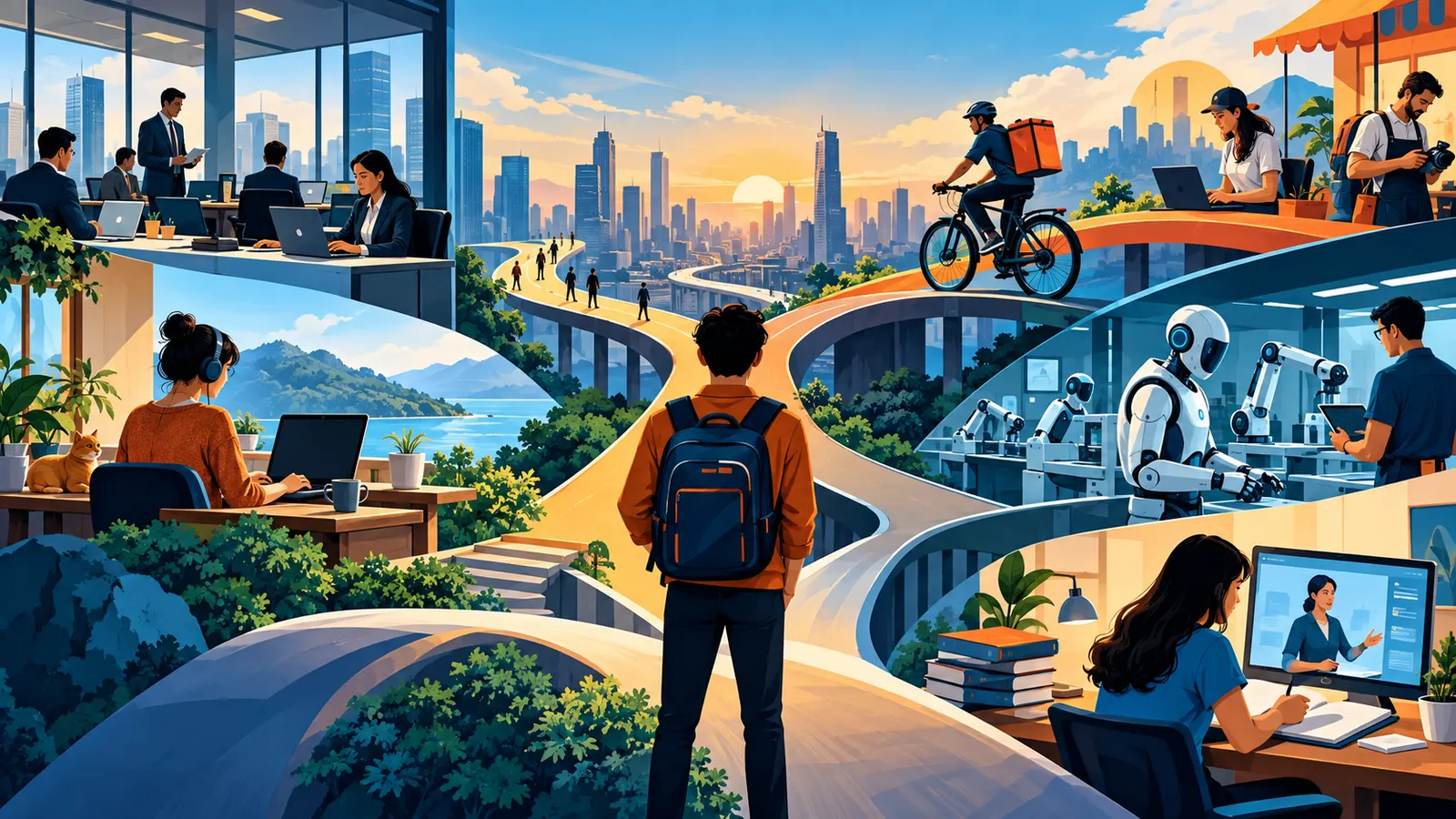
Work has always been more than a means of economic survival. Throughout human history, the nature of work has shaped social identity, personal dignity, community relationships, and individual aspirations. A person’s occupation often determines not only their income but also their sense of purpose and position within society. However, the meaning and structure of work are undergoing a profound transformation. Technological advancement, globalisation, automation, and changing economic models have disrupted traditional ideas about employment and created a new landscape of opportunities and uncertainties.
For much of the industrial era, work was organised around relatively stable structures. Individuals typically acquired skills, entered a profession, and expected long-term employment within a particular organisation. The relationship between employer and employee was often built around permanence, with predictable career progression and clearly defined responsibilities. This model shaped social expectations for generations.
The contemporary world of work, however, operates according to a different logic. Flexibility, adaptability, and continuous learning have become increasingly important. Careers are no longer always linear paths but rather evolving journeys involving multiple roles, industries, and skill transformations. While this shift has created new possibilities, it has also generated concerns about security, identity, and inequality.
One of the most significant forces reshaping work is technological advancement. Automation and artificial intelligence are changing the nature of tasks performed by humans. Machines can increasingly handle repetitive activities involving calculation, processing, and pattern recognition. This transformation has raised important questions about the future of employment and the relationship between humans and technology.
However, the impact of technology on work is more complex than the simple replacement of humans by machines. Historically, technological revolutions have eliminated certain forms of labour while creating entirely new occupations. The introduction of computers reduced demand for some traditional administrative roles but created opportunities in software development, data analysis, cybersecurity, and digital services.
The central challenge lies not merely in whether technology will eliminate jobs, but in whether societies can enable workers to transition into emerging opportunities. Individuals who possess adaptable skills and access to quality education may benefit from technological change, while those whose skills become outdated may face greater difficulties.
This creates a growing emphasis on lifelong learning. In earlier generations, education was often viewed as a stage completed before entering the workforce. Today, learning has become an ongoing process. The rapid evolution of industries means that knowledge and skills require constant renewal. Workers must continuously update themselves to remain relevant in changing environments.
However, expecting individuals alone to manage these transitions overlooks broader structural realities. Access to skill development, digital resources, and professional networks is not equally distributed. A highly educated professional in a major city may easily access online courses and career opportunities, while a worker in a disadvantaged region may struggle due to limited resources. Therefore, technological transformation can potentially widen existing inequalities if opportunities for adaptation are unevenly available.
Another major transformation in modern work is the rise of the gig economy. Digital platforms have enabled individuals to offer services on flexible terms, creating new forms of employment outside traditional organisational structures. Freelancing, contract-based work, and platform-based services have provided income opportunities for many people who value independence and flexibility.
Yet, the gig economy also raises questions about labour protection and economic security. Traditional employment often provided benefits such as healthcare support, retirement plans, and job stability. Many gig workers operate without similar protections, creating uncertainty about long-term financial security. The flexibility offered by such work can sometimes come at the cost of predictability.
The changing nature of work has also influenced the relationship between professional and personal identity. Historically, occupations often became central components of identity. People introduced themselves through their professions, and careers represented long-term social status. In the modern economy, where individuals may change careers multiple times, identity is becoming less tied to a single occupation.
This transformation can be liberating because it allows individuals to explore diverse interests and redefine success. A person is no longer necessarily restricted by the profession they choose at an early stage of life. However, this flexibility can also create uncertainty. When work becomes unstable, individuals may struggle to establish a consistent sense of purpose and belonging.
The rise of remote work has further challenged traditional assumptions about workplaces. Physical offices were once considered essential environments for collaboration and productivity. Advances in communication technology have demonstrated that many forms of work can be performed from different locations. This has provided employees with greater flexibility and changed expectations about work-life balance.
However, remote work has also introduced new complexities. While some individuals experience greater autonomy, others face blurred boundaries between professional and personal life. When the workplace enters the home environment, the distinction between working hours and personal time can become unclear.
Gender dynamics within work have also evolved significantly. Increasing participation of women in professional spaces has challenged traditional assumptions about economic roles and household responsibilities. Yet, despite progress, many societies continue to experience unequal distribution of domestic labour. Professional equality cannot be achieved completely unless unpaid caregiving responsibilities are also addressed.
Another important dimension of changing work patterns is the growing importance of creativity and human skills. As machines become more capable of performing routine tasks, uniquely human abilities such as critical thinking, emotional intelligence, communication, and ethical judgement become increasingly valuable. The future of work may not be defined by competition between humans and machines but by collaboration between them.
This perspective requires rethinking education systems. Traditional education models often emphasised memorisation and fixed knowledge. However, modern economies increasingly require adaptability, problem-solving, and the ability to learn independently. Preparing individuals for the future of work requires developing not only technical skills but also intellectual flexibility.
The transformation of work also raises philosophical questions about the meaning of productivity. Modern societies often measure success through economic output and professional achievement. However, work is only one aspect of human life. A society that values individuals solely based on employment status risks ignoring important forms of contribution, including caregiving, volunteering, and community participation.
Ultimately, the changing nature of work reflects a broader transformation in how societies understand human potential. The future workplace will likely be characterised by greater flexibility, technological integration, and continuous adaptation. The challenge is ensuring that these changes expand opportunities rather than create deeper divisions.
Work has always evolved alongside human civilisation. The question is not whether change can be avoided, but whether societies can manage change in a way that preserves dignity, security, and opportunity for all. The future of work will depend not only on technological capability but also on social choices about fairness, inclusion, and the value placed on human contribution.