









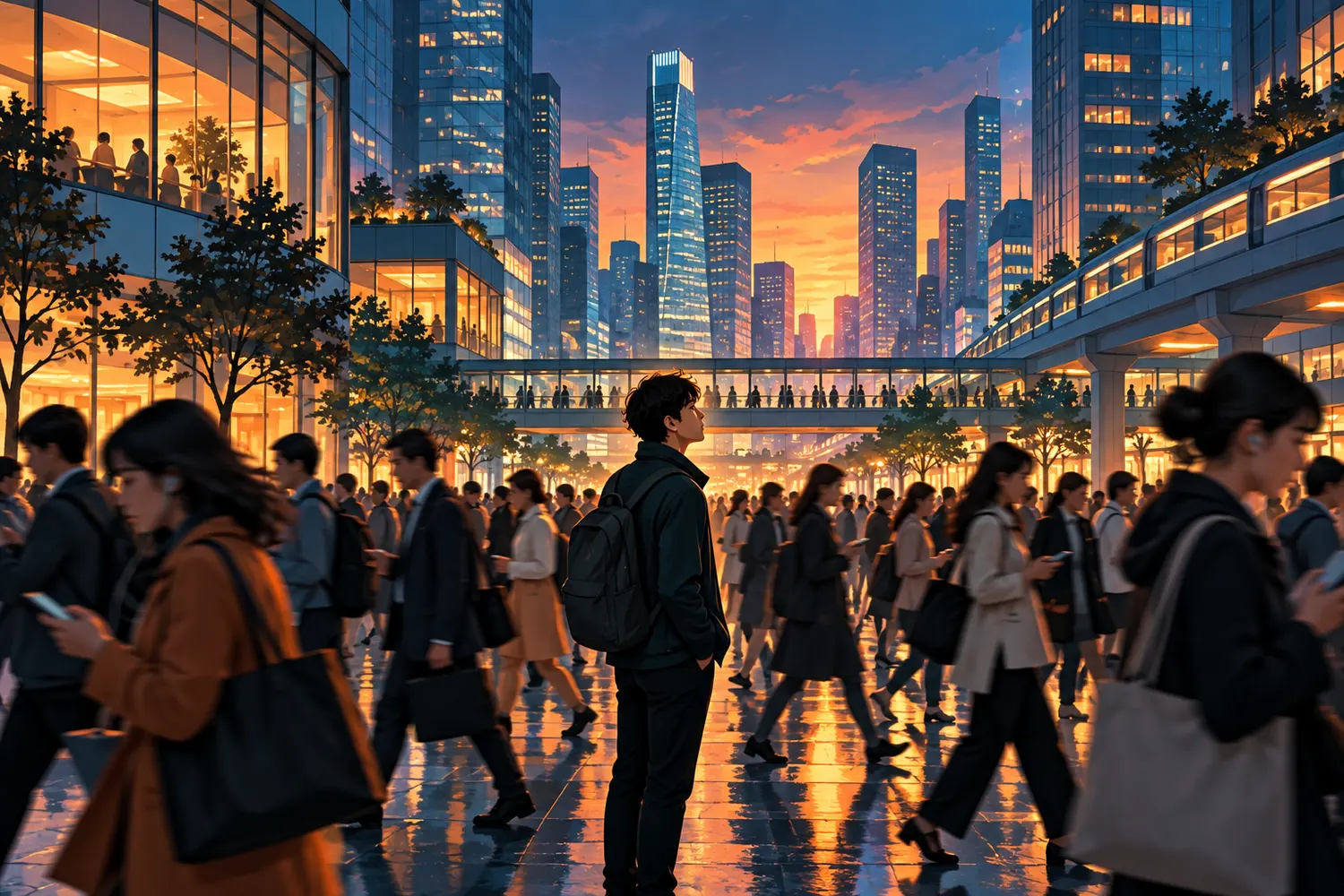
The modern city is often imagined as a symbol of human progress. It represents opportunity, ambition, innovation, and the possibility of reinvention. For millions of people, cities are spaces where inherited limitations can be challenged and new identities can be constructed. The movement from villages to urban centres has historically been associated with economic advancement, improved access to education, healthcare, and exposure to diverse cultures. Yet, beneath the visible energy of metropolitan life lies a quieter and increasingly significant social phenomenon: loneliness.
The paradox of urbanisation is that cities bring people physically closer while often pushing them emotionally further apart. A person may live among millions, travel through crowded streets every day, and interact with countless individuals, yet still experience a profound sense of isolation. This contradiction challenges the assumption that human connection naturally increases with population density. Instead, modern urban life reveals that proximity and belonging are not necessarily the same.
Urbanisation is not merely the expansion of physical settlements; it represents a transformation in the way people organise their lives, relationships, and identities. Traditional communities were often built around long-term relationships, shared histories, and repeated interactions. Villages and small towns typically provided individuals with deeply rooted social networks where people knew each other across generations. While such systems could sometimes restrict personal freedom through social pressure and rigid expectations, they also offered a strong sense of collective belonging.
Cities operate according to a different social logic. Urban environments are characterised by mobility, anonymity, and diversity. People frequently move between cities for education, employment, and economic opportunities. While this mobility allows individuals to escape restrictive environments and explore new possibilities, it can also weaken the stable social connections that provide emotional security.
One of the defining features of urban life is anonymity. Unlike traditional communities where individuals are recognised through family connections and social history, cities allow people to exist without extensive social identification. This anonymity can be liberating because it provides freedom from constant judgement. However, it can also create emotional detachment. When individuals become invisible within a crowd, they may struggle to develop meaningful relationships.
The architecture of cities also influences social interaction. Many modern urban spaces are designed primarily around efficiency, productivity, and economic activity rather than human connection. High-rise apartments, long commuting distances, and rapidly changing neighbourhoods can reduce opportunities for casual interactions that historically helped build community relationships.
A person living in a large apartment complex may share walls with hundreds of neighbours but rarely know their names. The physical closeness of urban housing does not automatically produce social intimacy. In some cases, urban design creates what can be described as “organised isolation” — environments where people coexist efficiently but remain socially disconnected.
The workplace has also become a central site of both connection and loneliness. For many urban residents, professional environments provide their primary social interactions. However, workplace relationships are often structured around performance, competition, and professional roles rather than emotional vulnerability. Individuals may have extensive professional networks while lacking deeper personal connections.
Technology has further complicated the relationship between urbanisation and loneliness. Digital platforms have created unprecedented opportunities for communication, allowing people to maintain relationships across distances and discover communities based on shared interests. However, digital connectivity can sometimes substitute superficial interaction for genuine companionship.
The modern individual can communicate instantly with hundreds of people while simultaneously experiencing emotional isolation. A constant flow of notifications and online interactions may create the appearance of social engagement without providing the psychological benefits associated with meaningful relationships.
This issue is particularly significant among young urban populations. Students and young professionals often move away from their families and familiar communities to pursue opportunities in major cities. Although this migration can represent independence and growth, it also involves separation from established support systems. The pressure to succeed professionally may further limit the time and emotional energy available for building relationships.
However, loneliness in cities should not be understood simply as a personal failure to form friendships. It is also connected to broader structural changes. Modern economies often reward individual achievement, flexibility, and competition. People are encouraged to constantly improve themselves, advance their careers, and remain productive. While ambition can create progress, excessive emphasis on individual success may weaken collective forms of care.
The relationship between urbanisation and loneliness also raises questions about the meaning of community in modern societies. Earlier communities were often based on shared location, family ties, or cultural traditions. Contemporary communities increasingly require active creation. People must intentionally build relationships through interest groups, neighbourhood initiatives, social organisations, or shared activities.
This shift represents both a challenge and an opportunity. Unlike traditional communities, modern urban communities can be more diverse and inclusive. People can form connections based on values, interests, and experiences rather than only birth or geography. A city can become a place where individuals discover communities they may never have encountered elsewhere.
The solution to urban loneliness, therefore, is not necessarily a return to older social structures. Traditional systems also had limitations, including exclusion, conformity, and restricted individual choices. The challenge is to create urban environments that combine the freedom of modern cities with the emotional support traditionally provided by close communities.
Urban planning has an important role in this process. Public parks, pedestrian-friendly spaces, community centres, libraries, and cultural institutions can encourage social interaction. Cities designed only for transportation and economic activity may neglect the human need for connection. A successful city must not only move people efficiently; it must also allow them to meet, interact, and belong.
The issue of loneliness also requires a cultural shift. Societies often celebrate independence but underestimate the importance of interdependence. Human beings are not designed to function entirely as isolated individuals. Emotional well-being depends on relationships, shared experiences, and mutual support.
Ultimately, the greatest challenge of urbanisation is not simply managing population growth or infrastructure demands. It is ensuring that cities remain human spaces. A city should not be measured only by its skyscrapers, economic output, or technological advancement, but also by whether individuals living within it feel recognised and connected.
The future of urban life will depend on whether societies can address this paradox: how to create cities where people are surrounded by others without feeling alone. The success of urbanisation will not merely be determined by how many people cities can accommodate, but by how meaningfully those people can coexist.